On the western tip of the island of
Usedom is Peenemunde, which is the original
"Cape
Canaveral"
best known for the ultra-secret Nazi city and
most important Nazi Army Research Center where
the Rocket Age, Space
Age and Jet Age began during the Second
World War. Though, the first jet engine was
invented by Sir Frank Whittle, an English
aviation engineer and pilot, the first
operational jet engine was designed by Hans
Joachim Pabst von Ohain, a German physicist and
developed in Peenemunde. Peenemunde was also
where the first liquid fuel rockets were
developed, and where German jet engines used in Messerschmitt fighter planes were
tested. It was also where CCTV was used for the first
time in 1942. And there were other top secret
projects worked on at this site such as the Nazi
UFO and Die
Glocke
(The Bell).
The vertical start V2 rocket at the Peenemunde Museum
Few know the greatest unsung hero
behind rocket science. Rocket science can be
traced back to a Polish military engineer Kazimerz
Siemieniowicz, who wrote the first book in the
world to systematically present knowledge about
the development of multistage rockets and rocket
artillery in the 17th century. Published in
Amsterdam in 1650 in Latin, the book was
translated into French in 1651, German in 1676,
English and Dutch in 1729, and Polish in 1963.
It wasn't until a few centuries later that Werner
von Braun
was greatly inspired by Robert
H. Goddard,
who was mentored by Hermann
Oberth.
Oberth also assisted von Braun in Peenemunde. Von
Braun once said that he developed the V2
rocket in
Peenemunde during WWII with the hope that it
would be used for space travel in the future. As
noble as that may sound, history has shown
otherwise.
After WWII, the V2 rocket was taken to White
Sands, New
Mexico, and it was the first man made object in
history to reach outer-space. However, the first
rockets that took the first satellites into space
Sputnik
1 and Explorer
1 were
designed on Kazimerz Siemieniowicz's 17th century
multistage rocket idea.
The V1 rocket on its horizontal starting track at the Peenemunde Museum
Earlier ultra-secret technological
projects such as the V1 rocket were also
developed in Peenemunde by other teams of
scientists. But the slow and problematic V1
rockets were abandoned due to technical issues,
and replaced by V2 rockets.
The first US rocket to reach an altitude of 244
miles, high above the 62-mile Karman line that
divides Earth's atmosphere and space was an
original V2 rocket that was seized and
transported to the US after the WWII. It was
launched for the first time from White
Sands Proving Ground in New Mexico on February 24, 1949,
and the rockets were later used in NASA space
projects.
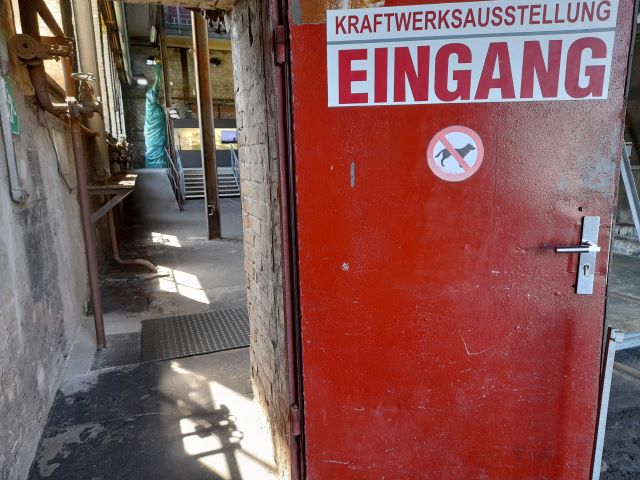
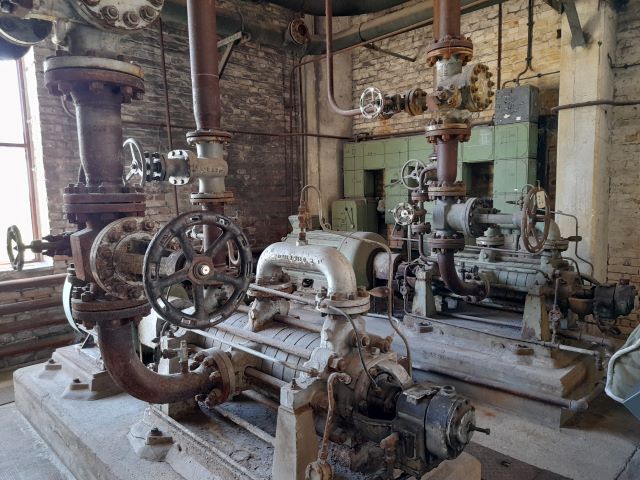
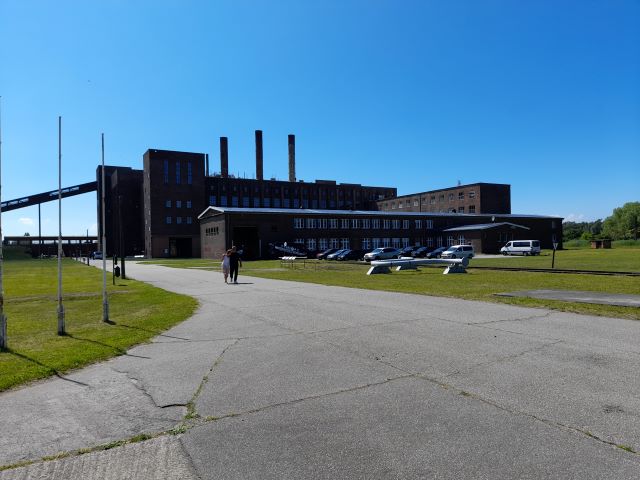
The Peenemunde power plant was not the largest building at this site. But it is the only one that survided to our times.
It was the most powerful electric power plant in the world, at that time, that produced gigantic amounts of power needed mostly
for production of 12 1/2 tons of liquid oxygen, every day. It was one of the most important components of the rocket fuel.
Every single V2 rocket used 4 tons of liquid oxygen.
After World War II, Peenemunde Army
Research Center was seized by Russians, who
developed their R-7
ICBM rocket
based on von Braun's designs. The Russian R-7
ICBM rocket launched Sputnik into space on October 4,
1957. It was the first rocket, which actually
went into space. And that event marks the
beginning of the Space
Race. But
the foundational developments to suborbital space
flights started before that in Peenemunde on the
island of Usedom. American, Russian and Chinese
multistage rockets still use Kazimerz
Siemieniowicz's invention, and technologies that
were developed and used for the first time in
Peenemunde.
The site of the Rocket City was bombed during the
war and is in disrepair. Now, the remains of its
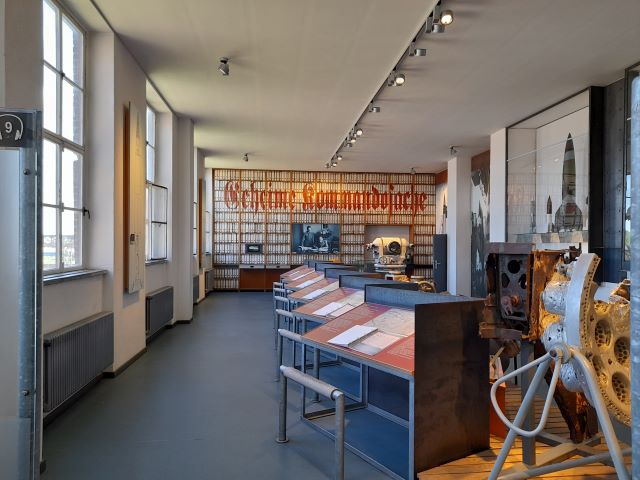
enormous power plant houses the Peenemunde Museum
of Technology. Please check the museum's website for visiting hours and
ticket information. The museum can be reached by
car or UBB train. There is also a bus that
goes around the Peenemunde historical site and
its airport. Those who would like to fly to
Peenemunde will be pleased to know that Peenemunde
Airfield
has a long runway and the author was told that is
can handle light passenger aircraft traffic. It
was originally built as part of the original army
research center.
There are
stories of a UFO hidden somewhere in a bunker at
Peenemunde, but it has never been found. If there
was one and Russians found it, they would have
probably taken it back to Russia with them a long
time ago. But there is no evidence of that
either. The Peenemunde's underground
constructions have not yet been fully explored,
and there have been some UFO sightings in the
area on the island of Usedom. However, most of
those did not resembled the Nazi UFO or Die
Glocke.
Although
Peenemunde is best known for the Rocket City and
technological museum, there are other sites and
museums there dedicated to other interesting
subjects. One of those is a U-Boot Museum docked
next to the technological museum, which is worth
visiting. There is also a doll museum with a
collection of antique dolls; some of which are
over 200 years old. The doll museum was created
by Erhard Diller, and it is more then just a
museum. Exhibitions show how dolls and toys were
exploited by regimes for brainwashing of
children. There is also the Phaenomenta
Museum
where one can experience laws of physics and
learn more about them.
Neighboring
resort town of Karlshagen was also a part of the Peenemunde
Army Research Center. After the war, a monument was raised in Karlshagen
to commemorate the victims of concentration camp
forced labor that were worked to death in that
army base.
Just as Werner von Braun was greatly inspired by
Robert H. Goddard, the Wright
Brothers
were greatly inspired by Otto
Lilienthal.
who invented gliders. Lilienthal was the first
person to make well-documented and successful
repeated gliding flights. Coincidentally, Otto
Lilienthal was born in the nearby town of Anklam, which is located on the
main land, across the Peene
River,
from which Peenemunde gets its name. Lilienthal's
study of birds have lead him to the invention of
gliders, and have given birth to the aviation
age. His
work has also lead to the birth of the latest
aircraft wing designs. The Otto
Lilienthal Museum is located nearby in Anklam, which
is also worth a visit.




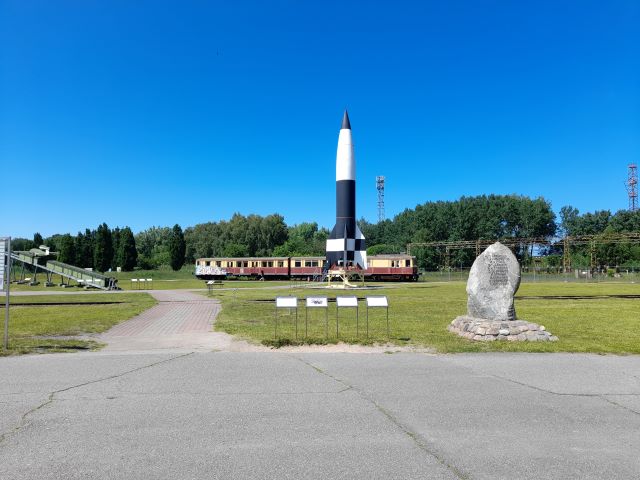 The vertical start V2 rocket at the Peenemunde Museum
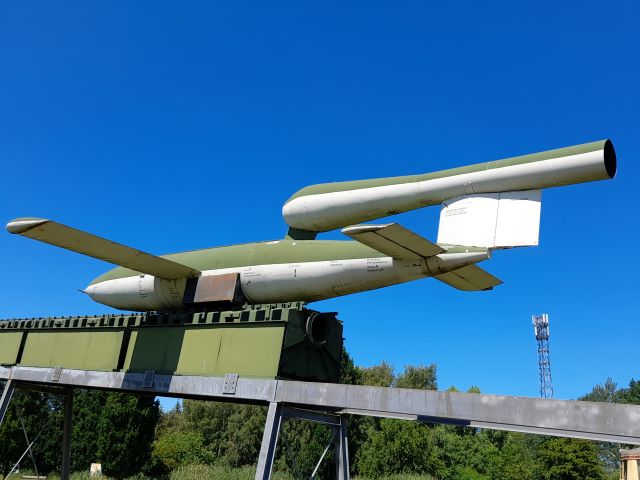 The V1 rocket on its horizontal starting track at the Peenemunde Museum
 The Peenemunde power plant was not the largest building at this site. But it is the only one that survided to our times.
It was the most powerful electric power plant in the world, at that time, that produced gigantic amounts of power needed mostly
for production of 12 1/2 tons of liquid oxygen, every day. It was one of the most important components of the rocket fuel.
Every single V2 rocket used 4 tons of liquid oxygen.
The Peenemunde power plant was not the largest building at this site. But it is the only one that survided to our times.
It was the most powerful electric power plant in the world, at that time, that produced gigantic amounts of power needed mostly
for production of 12 1/2 tons of liquid oxygen, every day. It was one of the most important components of the rocket fuel.
Every single V2 rocket used 4 tons of liquid oxygen.